
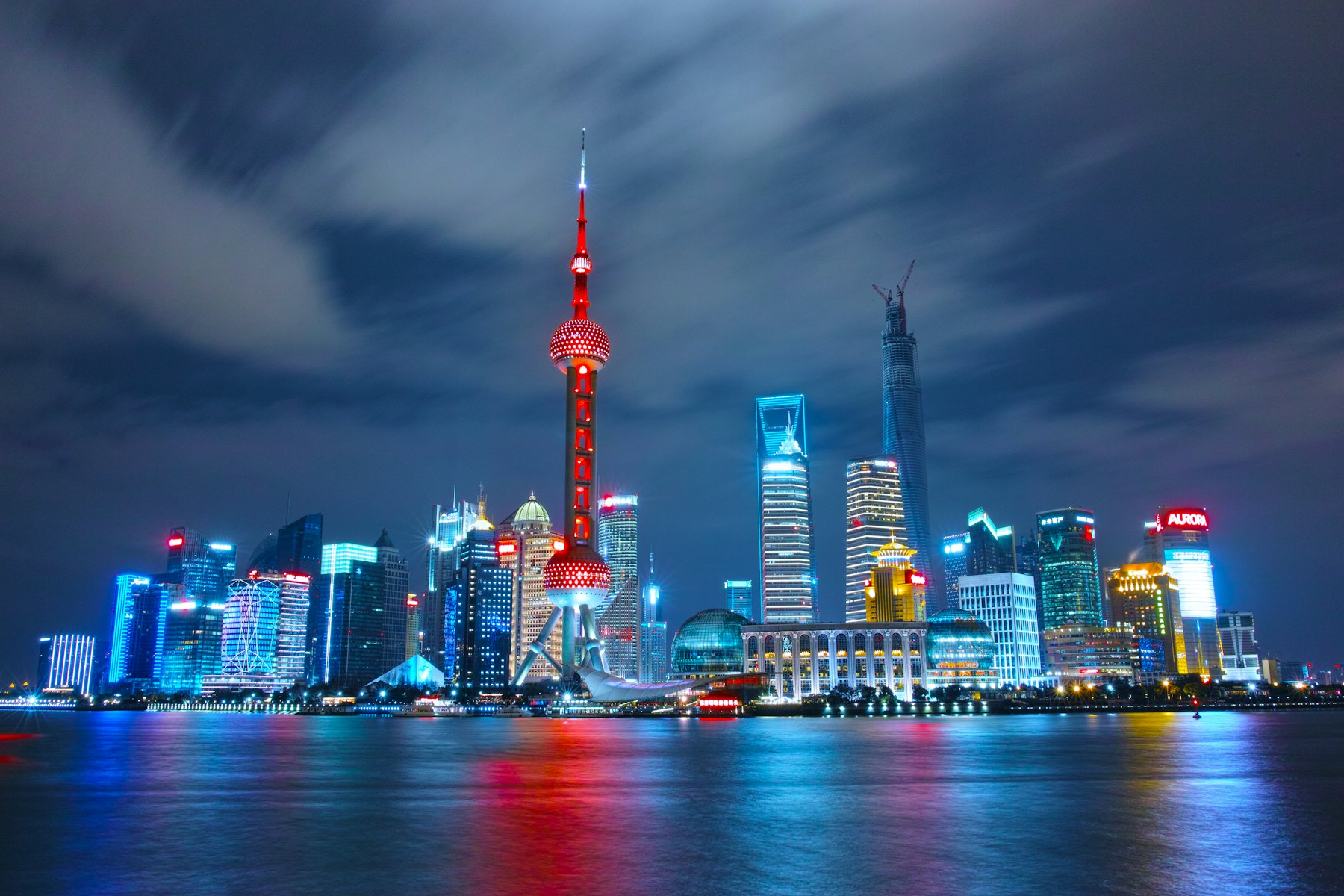
Shanghai, contrast
turned into a city
In Shanghai a 1920s bank and a 2020s tower share the same pavement. This is the China that changed fastest, and the one that rewards walking most.
Shanghai isn't monumental China: it's contemporary China. Its value lies in the mix — colonial architecture on the Bund facing the Pudong skyline — and in its neighbourhoods, which are best seen on foot.
Two days cover the core; three let you add Zhujiajiao, Suzhou or Hangzhou, the classics of the Yangtze delta.
What to see
The Bund (Waitan)
1.5 km of 1920s and 1930s buildings facing the Huangpu River. At dusk Pudong lights up on the far bank: the most famous view in China.
Pudong and its viewing decks
The Oriental Pearl Tower, Shanghai Tower (632 m) and the glass-floored deck of the World Financial Center. Timed tickets required.
Yu Garden and the Old Town
A 16th-century classical garden of rockeries, ponds and pavilions. Around it, the city's most touristy — and most fun — market.
The French Concession and Wukang Road
Plane trees, brick villas and cafés. Day-to-day Shanghai, and the best district for walking with no plan at all.
Jade Buddha Temple
Working temples with monks and two jade statues. Ten minutes from the centre and rarely full.
Shanghai Museum
One of the best museums in China, with bronzes, ceramics and calligraphy. Free entry and a great rainy-day option.
How to split your days
Shanghai rewards walking. One day for the Bund–Yu Garden–French Concession axis and another for Pudong, the museum and the Jade Buddha Temple works beautifully.
- Day 1 — The Bund in the morning, Yu Garden, the French Concession at dusk.
- Day 2 — A Pudong viewing deck, Shanghai Museum, Jade Buddha Temple.
- Day 3 (optional) — Suzhou, Hangzhou or the water town of Zhujiajiao.
When to travel to Shanghai
March to May and October to November are best. Summer is humid and hot; winter is cold and grey, though the city runs as normal.
- March–May — mild, with cherry blossom in early April.
- June–September — hot, humid and typhoon season; pack rain gear.
- October–November — crisp and clear, the best light of the year.
- December–February — cold and grey, but low-season prices.
Shanghai as a base
It's the best base in the east: high-speed trains reach Suzhou (25 min), Hangzhou (45 min) and Nanjing (70 min). If your trip covers the delta, sleep here three nights. We also handle airport meet-and-greet at Pudong or Hongqiao with a licensed English-speaking guide and a name board.
- The Bund is at its best at blue hour, just before the lights come on.
- Viewing decks sell timed slots; the Shanghai Tower has the best height.
- The metro is clean, cheap and signed in English — the fastest way around.
- For the skyline, the public ferry across the river costs under a euro and gives the best view.
Frequently asked questions
Shanghai or Beijing first?
Is a viewing deck worth it?
Can I visit Shanghai without a guide?
Shall we plan your trip to Shanghai?
Tell us your dates and who is travelling, and we'll send a tailor-made itinerary for Shanghai and the rest of China.
Open WhatsApp nowDirect contact
Every channel reaches the same team in China. Pick whichever you already use.
WA WhatsApp+86 177 0971 7171 — the fastest way to reach us →