
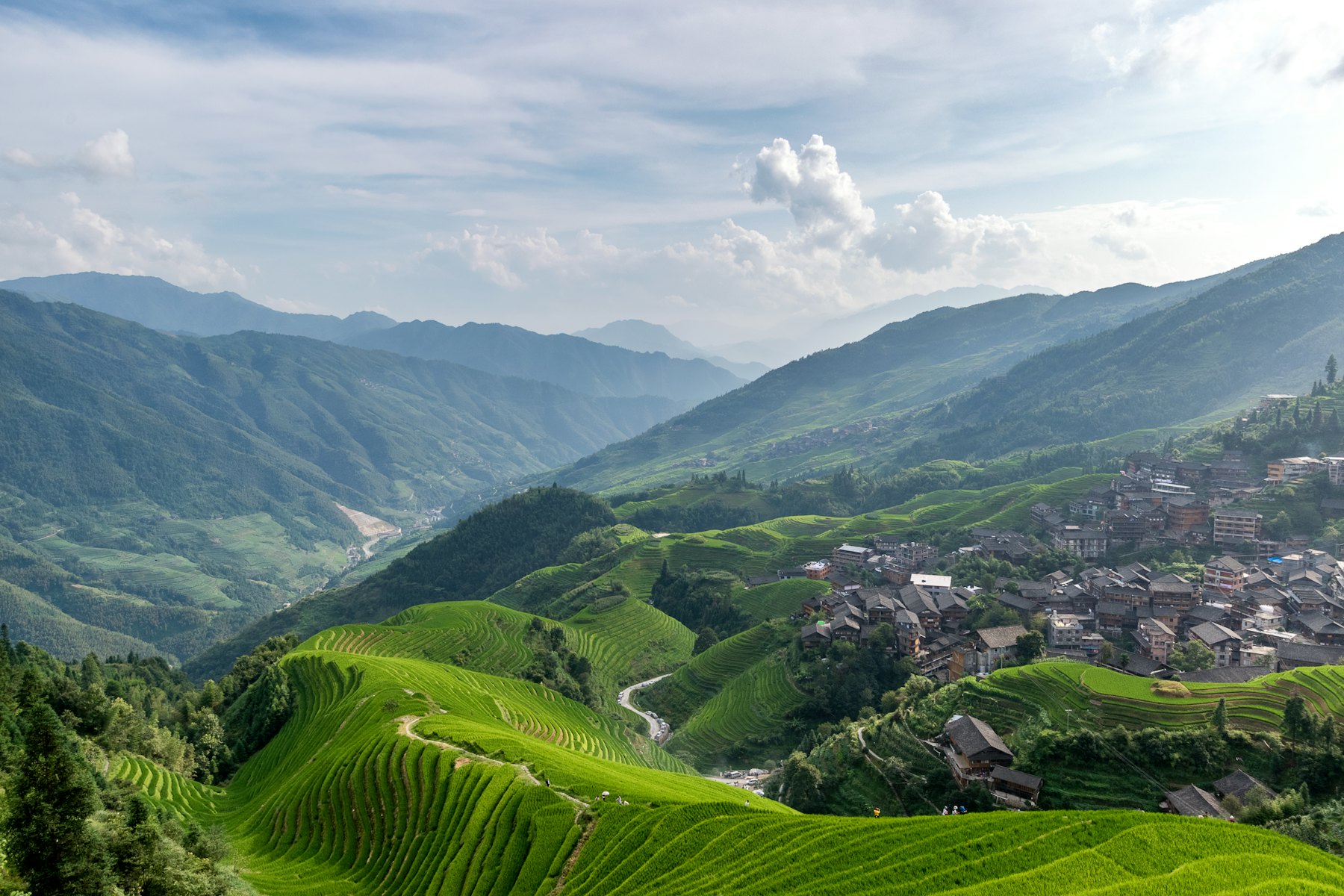
Where you sleep in China shapes the trip more than in most countries, and not only because of price. The choice is really a choice of style and of access: a glass tower in Shanghai puts you in the middle of the city, but a timber guesthouse above the rice terraces of Longji puts you inside the landscape everyone else only photographs from a viewpoint and then drives away from. Both are good. The mistake is to book the wrong one for the wrong night.
This guide is the practical map of the options: the full range of accommodation, the one rule that trips up foreign travellers most often, what each category costs in CNY and in pounds, how to book, where a guesthouse is genuinely worth the extra effort, and the honest downsides nobody mentions in the brochure. It is written for English-speaking visitors on UK, US, Australian, Canadian or Singaporean passports, because the check-in rules bite hardest on exactly those documents.
The full range, from five-star towers to a wooden house on a hillside
It helps to think of Chinese accommodation as six overlapping layers rather than two categories of good and cheap. Roughly in order from the most familiar to the most local, they are: international chains (the names you already know); domestic business hotels run by the big Chinese groups such as H World / Huazhu, Atour and Jin Jiang; boutique design hotels; minsu and kezhan guesthouses, the Chinese equivalents of a small country inn; hostels, which in China are usually cleaner and quieter than reputation suggests; and converted heritage homes.
That last group is the one that makes a Chinese trip memorable, and it is genuinely varied. It includes the siheyuan, the courtyard homes of Beijing, now often restored as small hotels inside the old hutong lanes; the 1930s lane houses of Shanghai and the old colonial shophouses of Xiamen; the tulou, the enormous round earthen clan buildings of Fujian; and the Hui-style white-walled, black-tiled merchant compounds of villages like Hongcun and Wuyuan. Staying in one is not luxury in the five-star sense, but it is a different trip.
| Type | Typical feel | Best for |
|---|---|---|
| International five-star | Predictable, English-speaking staff, full facilities | First night, business travel, travellers who want zero surprises |
| Domestic business hotel | Modern, spotless, compact rooms, good value | Most nights of a city-based trip |
| Boutique design hotel | Individual, often heritage buildings, small | Anniversaries and a slower pace in one city |
| Minsu / kezhan guesthouse | Family-run, character, fewer amenities | Small towns, mountains, rice terraces, old quarters |
| Hostel | Dorms and private rooms, sociable, very cheap | Solo travellers and longer budget trips |
| Converted courtyard or heritage home | Historic building, thin walls, real atmosphere | One or two nights you will actually remember |
Not every guesthouse is allowed to take your passport
This is the single most important thing on this page. Not every guesthouse or homestay is licensed to register foreign guests. The rules were eased after 2003, and in the big cities and the well-known tourist towns almost everything accepts foreign passports now. But remote areas and small family-run places can still refuse foreign guests, sometimes politely, sometimes only when you turn up at the door with your bag.
The fix is simple: confirm before you book that the property accepts foreign guests, and get it in writing. On a booking site, look for the phrase in the room details rather than the reviews; when booking direct, ask the question on WeChat and keep the reply. A property that answers vaguely, or that asks what passport you hold before answering, is usually telling you something. The worst-case scenario is being turned away at night in a small town with nowhere else to go, and it happens often enough to plan around.
Check-in and the temporary-residence registration
Every foreign visitor in China has to be registered with the local police within 24 hours of arriving at an address, and hotels do this for you automatically. When you check in you must show your passport in person, for this mandatory temporary-residence registration. The owner or the front desk scans or photographs the document into the police system on the spot, and it usually takes a few minutes.
Two related details save time. If you are moving between several places, expect the same passport ritual at every one of them, so keep the document within easy reach rather than buried in a suitcase. And if you arrive late, tell the property your arrival time and agree it in advance, because the registration is done by a person, not by software.
What things cost, in CNY and in pounds
Prices below are rough per-room, per-night figures, and they vary widely by city, by season and by how far ahead you book. A bed in Shanghai during a national holiday can cost what a good room costs in Kunming in the off-season. Use them as a scale, not a quote, and always check the live rate for your dates.
| Category | Roughly per night (CNY) | Rough GBP / USD |
|---|---|---|
| Hostel dorm bed | CNY 60-150 | about GBP 7-17 / USD 8-21 |
| Budget chain hotel | CNY 180-350 | about GBP 20-40 / USD 25-48 |
| Mid-range business hotel | CNY 400-750 | about GBP 45-85 / USD 55-105 |
| Boutique guesthouse / courtyard inn | CNY 600-1,600 | about GBP 70-180 / USD 85-220 |
| International five-star | CNY 1,200-3,000+ | about GBP 130-340+ / USD 165-410+ |
Two rules of thumb hold across the country. Outside the biggest cities and outside peak holidays, everything above drops by a third or more. And within a single city, moving one metro stop away from the main tourist street often moves you down a whole bracket, with no loss of comfort at all.
Where to book, and when booking direct wins
Foreign-facing booking sites and Chinese domestic platforms do not carry identical inventory. For the fullest domestic inventory and the widest choice of small guesthouses, the Chinese platforms are Ctrip / Trip.com, Fliggy and Meituan. For a smoother foreign-card experience, Booking.com and Agoda are more forgiving with a non-Chinese card, and their cancellation terms are usually clearer to read in English.
- Ctrip / Trip.com: the broadest inventory across cities and small towns, with an English interface.
- Fliggy and Meituan: excellent for domestic guesthouses, weaker English, sometimes the only listing for a family inn.
- Booking.com / Agoda: the friendliest with foreign cards and English cancellation rules.
- Direct by WeChat or Xiaohongshu: often the cheapest, because the owner pays no commission, but it has no English interface and no English-language protection if something goes wrong.
Booking direct through an owner's WeChat is genuinely cheaper in many small guesthouses, sometimes by a third. The trade-off is that you are dealing with a person in Chinese, over a chat app, with no booking platform to mediate if the dates shift or the room is not what was agreed. It works beautifully when someone on your side can hold the conversation, and it is the reason guided travellers often end up in rooms that budget travellers never see.
Where a guesthouse stay is genuinely worth it
A guesthouse is not automatically better than a hotel. In a big city with an early flight, a business hotel near the metro is more useful in almost every way. But in certain places the guesthouse is the experience, and a standard hotel there would be a waste of the trip.
- Pingyao: the courtyard inns inside the walled old town, where you sleep in a restored Qing merchant compound.
- Lijiang and Dali: the Naxi and Bai courtyard compounds, built around a planted central court, quiet once the day-trippers leave.
- Longji rice terraces: the timber stilt houses of the Zhuang and Yao villages at Ping'an and Dazhai, hanging off the hillside above the fields.
- Wuyuan and Hongcun: Hui-style merchant houses with their white walls, black tiles and carved wooden screens.
- Beijing: converted hutong courtyards inside the old lanes of the centre, minutes from the Drum Tower.
- Shanghai: 1930s lane houses in the former French Concession, small and full of character, on plane-tree streets.
The common thread is location you cannot buy with a chain hotel: inside the walls, up the hill, on the lane, in the village. That is what you are paying the small premium for, not the thread count of the towels.
The honest downsides, and the compensations
Chinese guesthouses have character because they are old buildings, and old buildings come with old-building problems. It is worth going in with your eyes open, because the qualities that read as charming from a distance read as inconvenient at eleven at night.
- Thin walls. Sound travels in a timber or courtyard building, and neighbours, plumbing and early risers are all audible.
- Electric water heaters with a limited tank. The hot water can run out after two quick showers, so stagger them.
- No lifts. In a heritage building your room may be up two or three flights of a narrow wooden staircase.
- Breakfast is congee and steamed buns. Delicious, but not a full English, and rarely with proper coffee unless the place is aimed at foreigners.
Against that, the compensations are real and often outweigh the inconveniences. You get the owner's local knowledge, which is worth more than any guidebook, better than anything you will find online; luggage storage so you can leave bags and travel light for a night or two; and home cooking that is frequently the best meal of that leg of the trip. The trick is to see the downsides clearly and still choose the guesthouse for the two or three nights where it pays off.
Longji in detail: what a rice-terrace guesthouse is really like
The Longji rice terraces are the clearest example of a place where the guesthouse is the point, and also the clearest example of why a guesthouse needs planning. The villages of Ping'an and Dazhai sit high on the hillside above the terraced fields, and the roads do not go all the way up to them.
In practice, cars stop at the car park at the foot of the hill, and the guesthouses are up the mountain from there. Nobody expects you to carry a suitcase up the steps. Either the owner comes down for your bags or a local porter does, and the fee for that is small and entirely normal. Tell the property your arrival time in advance so somebody is waiting, and confirm how the bag transfer is arranged before you set off.
One thing to pack deliberately for Longji: earplugs. The timber buildings carry sound badly, so a person turning over in the next room is not a rumour but a fact, and the village wakes early. In exchange you get mist on the terraces at dawn from your own window, meals cooked by the family, and a night that feels nothing at all like a hotel.
Power, plugs and the small practicalities
China runs on 220V, 50Hz, which suits UK, European and most Asian devices without a voltage converter, since modern chargers are dual-voltage. What you will need is a plug adaptor, because the sockets are a mix of the two-flat-pin US / Japan type (A) and the two-round-pin type (C). UK three-pin plugs need an adaptor, without exception, and it is worth carrying two.
- Bring a multi-port USB charging brick: many guesthouses have only one or two sockets in the room.
- A short power strip turns a single awkward socket into a workable charging station.
- Check the voltage on any hair dryer or shaver before use, and prefer the hotel's own appliance.
- Downlights and bedside switches in older buildings can be confusing at night; a small torch or phone light helps.
The other practical habit is communication. WeChat is the main channel in China, so add the owner on WeChat before you travel, use a translation app inside the chat, and state your arrival time clearly. Many guesthouses have no 24-hour front desk, which is normal rather than a red flag, but it means a late arrival must be agreed in advance. A guesthouse that knows you land at nine will wait up for you; one that does not, will not.
Homestay or minsu, and where the money goes
The two words are often used as if they were interchangeable, and they are not. A minsu is a guesthouse: a small commercial inn, run by an owner, with rooms let to whoever books them. A homestay is something else, at least in the sense we use it here, which is living in a family home, eating at their table, joining the rhythm of the household for a night or two. Homestays are usually arranged by an operator, involve small numbers of guests at a time, and accept simpler conditions in return for a genuine human experience.
That distinction matters for two reasons. First, expectations: a homestay is a family's home, not a hotel with a family theme, and the comfort level reflects that. Second, money: on a well-run trip the fee should reach the family, not disappear into a booking platform. On that principle, the homestay fee is paid 100% directly to the local family, which is the rule at JoyoTour rather than the exception.
Booking this landscape well is not about finding the cheapest room; it is about matching the room to the night. This is where an operator earns its fee: JoyoTour's 150 itinerary designers, working since 1999 and across more than 100,000 travellers, keep a running list of which properties in each town are actually licensed to register foreign guests, and they book only from that list. Every booking is then backed by ChinaTour.es with 24/7 in-trip support in English, so if the room you were given is not the room you booked, there is someone awake to fix it.
Choose the tower when you want reliability, the business hotel when you want value, and the guesthouse or courtyard home when the place itself is worth the trouble. Sort the passport question out before you book, carry the real document to every check-in, and the rest of the accommodation puzzle, in China as anywhere, is simply a matter of reading the room.
Not sure which stay suits which night?
Tell us your route and your dates. An English-speaking adviser will match each town with the right kind of hotel or guesthouse, confirm which ones register foreign guests, and put it all in one itinerary before you pay.
Message us on WhatsAppWe're the destination agency behind ChinaTour.es. JoyoTour has been designing tailor-made trips since 1999 and has 150 itinerary designers across China, Southeast Asia, Europe and the Americas. More than 100,000 travellers have set off with us. Everything we write about here, we've travelled first.