
Asking when is the best time to travel to China is like asking when is the best time to visit the whole of Europe: it depends on the landscape you want, the latitude you are heading to and how much heat and crowd you can stand. The country spans five time zones, runs from tropical mangrove to the 5,000-metre Tibetan plateau, and has two monsoons that do not arrive at the same time. What is peak beach season in Hainan is minus twenty-five and house-sized ice sculptures in Harbin.
That said, there are stable patterns we confirm trip after trip. This guide goes month by month and region by region: what you see in each window, what you avoid and why. At the end are the two dates to dodge without discussion — October's Golden Week and Chinese New Year — the two variables that can ruin an otherwise perfect trip on their own.
China does not have one season: it has six
The first trap is in the mind. When people ask about the weather in China, they imagine a single country with a single climate. The reality is that Beijing and Guangzhou, two thousand kilometres apart, have almost opposite climates. The northeast is continental and dry, with brutal winters and short summers. The southeast is subtropical and humid, with a monsoon that empties from May to September. The mountain southwest of Yunnan and Sichuan enjoys perpetual spring at mid-altitude. The Tibetan plateau gets a punishing sun and dry cold at once.
So it is best to think in windows, not months. The window for the Guangxi rice terraces does not coincide with the window for the golden poplars of Inner Mongolia, even though they are only weeks apart. What almost every region shares are two peaks of domestic travel, and that is where it is really decided whether the trip is enjoyed or endured.
March to April: the south blooms and the north keeps its coat
March and April are the months of the Yangtze delta. In Suzhou, Hangzhou and the water towns of Zhejiang, plum blossom and then cherry blossom fill the classical gardens, and the temperature sits between 10 and 20°C: the best combination for walking all day. It is also tea season: the first Longjing harvest is picked in late March in the hills around Hangzhou, and watching the pickers with their baskets on their backs is one of those details no guidebook captures.
The price of this beauty is a fine, persistent rain, above all in April, and a north that has not caught up. In Beijing and on the Great Wall, there can be a cutting wind and even snow in March. If your trip combines south and north at these dates, pack in layers and a proper waterproof jacket rather than an umbrella, which in the south becomes a nuisance.
- Yangtze delta: gardens in bloom and the first tea harvest, between 10 and 20°C.
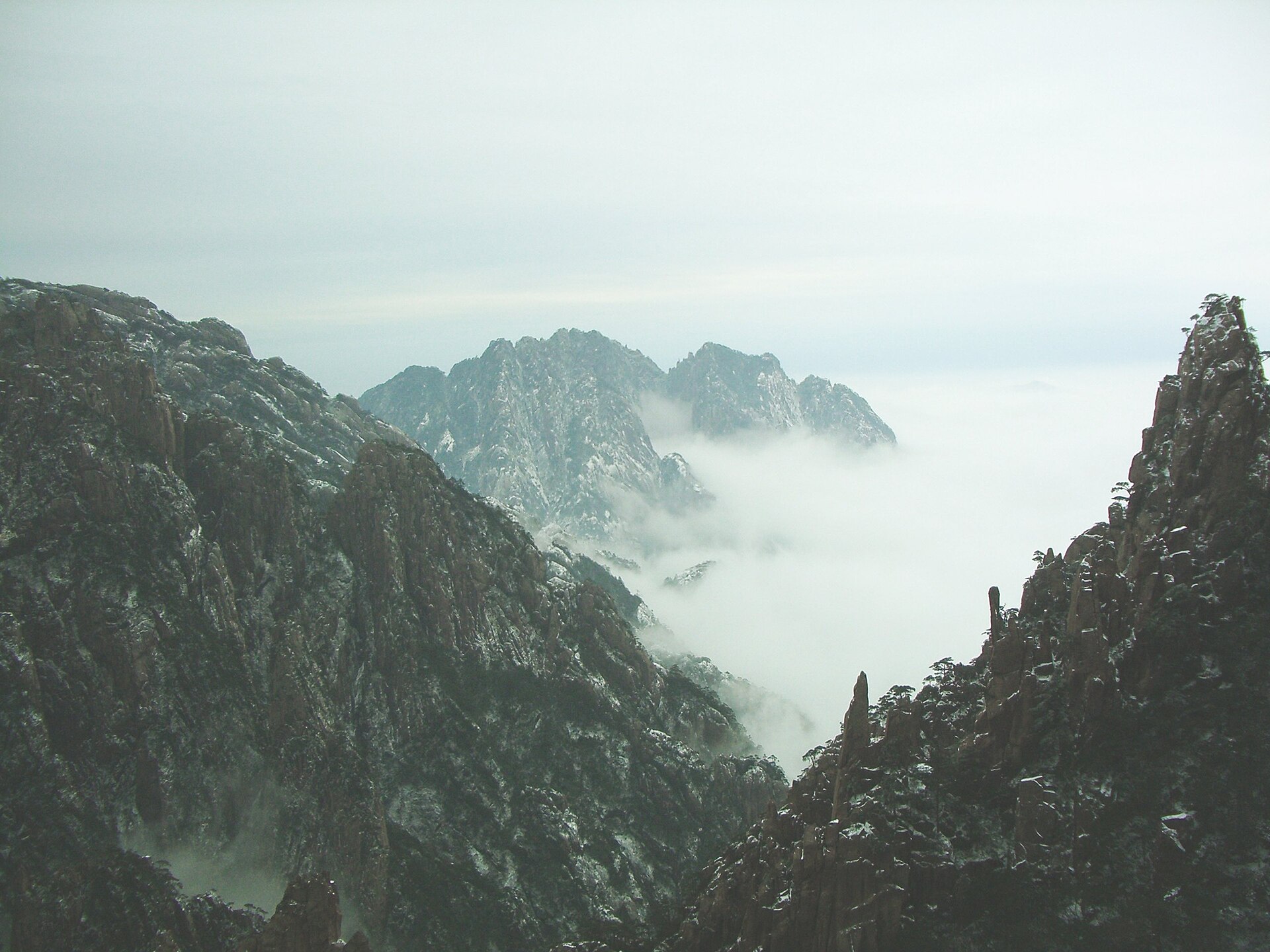
- Eastern mountains (Huangshan, Wuyishan): thick mist and ink-painting photographs, with fewer people than in summer.
- Beijing and the Great Wall: cold, wind and a chance of snow; fewer tourists than in autumn.
- Yunnan (Kunming, Dali): dry and pleasant, one of the best windows of the year.
May and June: the Longji terraces and the light before the rain
Mid-May and all of June is the classic window for the Longji rice terraces in Guangxi. In these weeks the terraces fill with water and the afternoon sun turns them into a mosaic of mirrors between the mountains. Local farmers plough and plant, so there is real activity in the landscape and not just a viewpoint with shops. For many people it is the most photogenic moment of the rice cycle.
It is also the start of the southern rains, with short but intense afternoon storms. The good news is that the May and early-June rain is not yet the deluge of July, and temperatures are bearable. In Guilin and Yangshuo, the Li river with morning mist is pure painting, though you must accept that the water level can rise and some river trips are occasionally suspended.
July: the Menyuan rapeseed and the humid heat of the east
July is the month of the Menyuan rapeseed sea in Qinghai, above 2,800 metres. For about three weeks the whole valley turns yellow to the horizon, with snow mountains behind. It is one of those landscapes that look impossible and exist only for a few days a year, which forces you to nail the date precisely if that is the aim of the trip.
Across the rest of the country, July is uncomfortable. Shanghai, Nanjing and Guangzhou enter the humid heat of the dog days, with thirty-five degrees and a humidity that makes two hours of walking exhausting. Beijing is hot but drier, and altitude cities such as Lhasa, Kunming or Xining are a huge relief. If you travel in July, go up and avoid the plains.
Chinese school holidays also begin, so domestic families appear in theme parks and the most popular cities. Book further ahead than usual, especially pool hotels and weekend high-speed trains.
August: monsoon, typhoons and the worst week of the calendar
August is the hardest month of the year in the southern half of the country. The monsoon empties hard, the southeast coast enters typhoon season and the humid heat peaks. It is not that you cannot travel, but you must choose the destination very carefully: the Tibetan plateau, Gansu, Qinghai and Inner Mongolia are at their best, with sunny days, little rain and pleasant temperatures at altitude.
If your plan includes the south in August, add a buffer day in case a flight is delayed by a typhoon and avoid maritime trips to the islands. The national parks of the southwest work well because the rain comes in afternoon showers rather than whole days.
- Tibetan plateau and Qinghai: peak season for the nomadic herders, with green grasslands and horse festivals.
- Gansu and the Grand Route: dry heat by day and cool nights, with the salt lakes at their best colour.
- Southeast coast and Hainan: typhoons and humidity; only advisable if you accept full flexibility.
- Big eastern cities: sticky heat, best to book indoor activities at midday.
September: golden rice, clean air and still-cheap prices
September is, for many travellers, the best hidden month of the year. The southern rains retreat, the heat eases, the sky clears, and the domestic crowds have not yet appeared, because the big peak comes in October. The Longji terraces already show the grain, turning from green to gold over the weeks, and the north enters its best climate of the year.
It is also an excellent month for long-distance hiking, with mild temperatures and clear views. In recent years we have seen September fill up more and more, but it is still quieter than October and considerably cheaper on flights and hotels. Itineraries that weigh landscape, weather and price usually land here, and it is a range JoyoTour designs very often for travellers who want the golden rice without the crowds.
October: the Ejina poplars and, in general, the best month
October is the great classic, with reason. The climate is dry and mild across almost the whole country, pollution drops, autumn colours appear in the north and the cities are at their best. The jewel of the month is the poplar forest of Ejina in Inner Mongolia, near the Mongolian border: for about two exact weeks the leaves of the Populus euphratica turn golden and the whole desert lights up. It is a spectacle confirmed year after year, with a very short window.
The problem with October is Golden Week, from the 1st to the 7th. In those seven days, half of China travels: trains sell out, hotels multiply their price and the great sights become a human tide. The solution is simple and we apply it every time: either head to peripheral regions the domestic crowds do not reach, or shift the trip to after the 8th, when the country returns to normal and the same routes sit half empty.
| Window | Ideal region | What you see |
|---|---|---|
| March–April | Lower Yangtze and Yunnan | Blossom and the first tea harvest |
| May–June | Guangxi and Guizhou | Flooded Longji terraces and storm light |
| July | Qinghai and Gansu | Menyuan rapeseed sea and high grasslands |
| September | North and big cities | Grain in the rice, clean air and mid prices |
| October (after the 8th) | Inner Mongolia and the north | Golden Ejina poplars and dry autumn |
| November–February | South and cities | Low season, museums and winter landscapes |
November to February: the low season and its real advantages
Winter sells badly and is enjoyed greatly. From November to February tickets drop, four-star hotels go for three-star prices, guides are available and the great sights, from the Forbidden City to the Terracotta Army, are walked calmly. The winter light, low and clean, is also the best of the year for photographing architecture and city walls.
The south lives its best off-season moment: Guangzhou, Guilin, the Fujian villages and Hainan are pleasant, with temperatures between 12 and 22°C. The north is another story: Beijing can drop below minus ten and Harbin becomes the great ice destination, with its sculpture festival from January. If your priority is seeing a lot for little and without queues, this is your stretch.
- Harbin and the northeast: the ice and snow festival from late December to February.
- Huangshan: frosted pines and a winter sea of clouds, the image of the classical paintings.
- Southern China: mild temperatures and low prices, even the beach in Hainan.
- Big cities: museums, food and shopping without the crush, with cheaper tickets.
The two dates to dodge without discussion
The first is Golden Week, the 1 to 7 October holiday, which combines the national day with the best weather of the year. It is the worst possible time to move around the great sights: high-speed tickets sell out in minutes, internal flights climb and the viewpoints fill with groups. The second is Chinese New Year, or Spring Festival, which shifts each year between late January and mid-February. For about fifteen days the whole country travels to reunite with its families.
Chinese New Year has two faces. On one hand, many small shops and restaurants close and some services suffer in the cities. On the other, the atmosphere is unrepeatable: red lanterns, New Year markets, fireworks and dragon-dance parades. If you fancy living that festival, go to a big city and accept the limitations; if what you want is to see the country as normal, avoid the two central weeks.
How to choose your dates around what you want to see
In the end, the best time to travel to China is deduced from a single question: what exactly do you want to see? If the landscape is clear, the date follows on its own. If what you want is a balanced trip of cities, history and landscape with no single goal, the answer is almost always September, October after the 8th, or May, before the heavy rains and the heat peak.
- Define the priority landscape: terraces, rapeseed, golden poplars, ice or beach.
- Mark the exact weeks of that phenomenon, because almost all last two or three weeks.
- Check where Golden Week and Chinese New Year fall in your year, and decide whether to dodge them or embrace them.
- Combine compatible regions within that window instead of crossing half the country for no reason.
- Book high-speed trains and the great sights in advance if you travel in high season.
If you would rather not turn this into a project, that is where an adviser's work comes in. ChinaTour.es, the English-language site of the JoyoTour group, reviews the real dates of each natural phenomenon with you and adjusts the order of the trip so the light and the weather play in your favour, not against you.
Shall we help you choose the date?
Tell us what you want to see and which month you can travel, and an English-speaking adviser proposes the best window with a tailor-made itinerary. Message us on WhatsApp and within three business days you have a first proposal.
Message us on WhatsAppWe're the destination agency behind ChinaTour.es. JoyoTour has been designing tailor-made trips since 1999 and has 150 itinerary designers across China, Southeast Asia, Europe and the Americas. More than 100,000 travellers have set off with us. Everything we write about here, we've travelled first.