
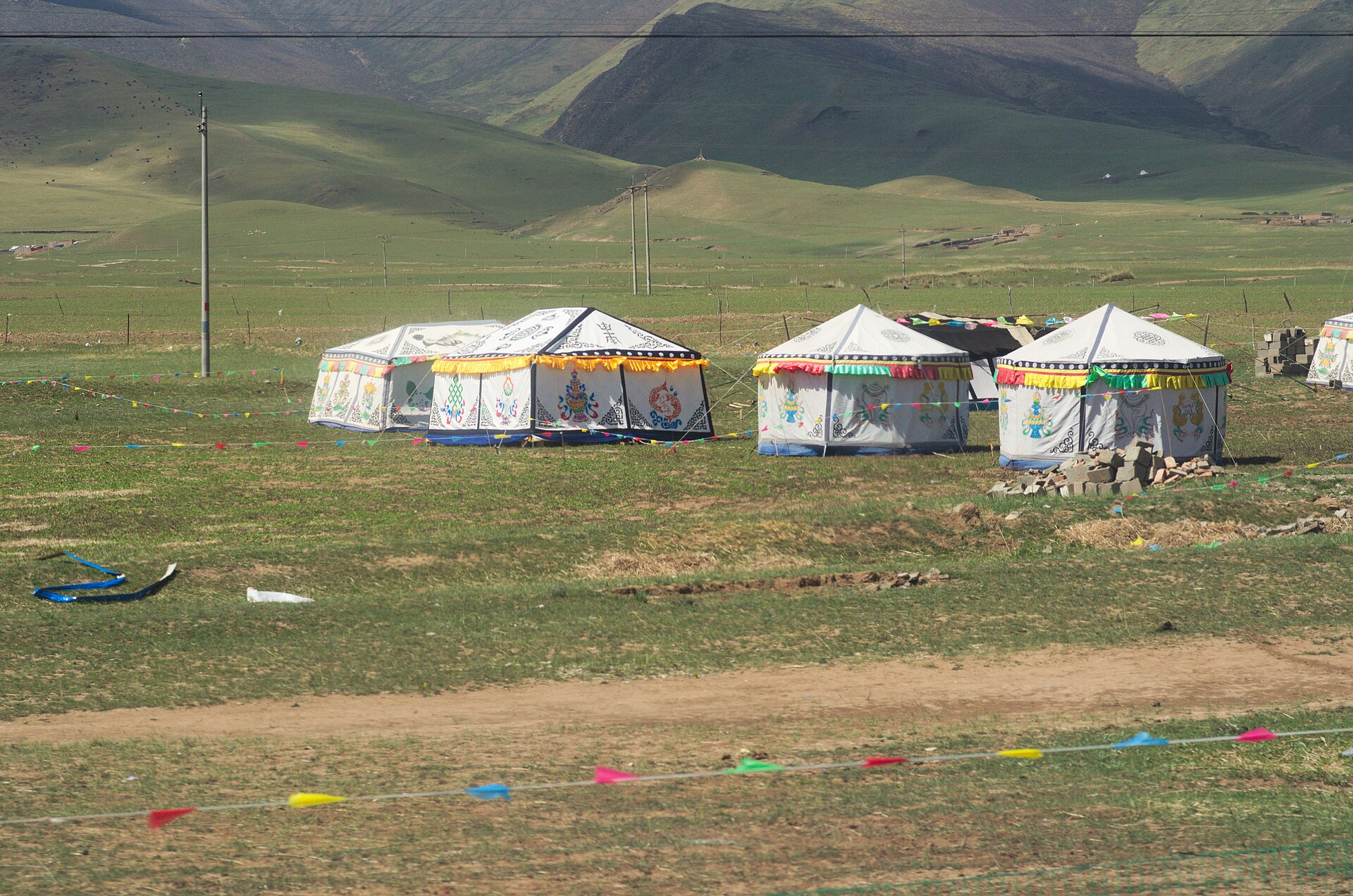
The Qinghai-Gansu Grand Route is the most spectacular road trip in China and, at the same time, one of the least known in the English-speaking world. Two thousand kilometres across the Tibetan plateau combine a salt lake the size of a sea, deserts, dunes, Buddhist caves 1,600 years old and rainbow-coloured mountains. It is usually driven in eight or nine days, almost always clockwise and with a private driver and guide.
After driving it many times and accompanying hundreds of travellers, we have collected the fifteen things that genuinely make a difference. These are not brochure tips: they are the complaints, the frights and the pleasant surprises that repeat themselves trip after trip, whatever the group.
The route in four lines
The journey starts and ends in Xining, the capital of Qinghai, and runs clockwise to make the most of the light and the altitude. The main stages are Qinghai Lake, Chaka Salt Lake, the Emerald Lake at Dachaidan, the yardangs on the water, Dunhuang, Jiayuguan, the Zhangye Danxia mountains, the Qilian grasslands and the return to Xining over the Menyuan pass.
The altitude is not extreme, but it is not a stroll either: you go from 1,139 metres at Dunhuang to more than 3,200 at Qinghai Lake, with mountain passes above 3,800. That is the factor to manage most carefully, and it is what decides how the stages are divided.
The 15 things at a glance
- You don't feel the altitude on the first day; you feel it on the second. Keep day one for acclimatisation.
- Climb slowly: Xining, at 2,275 metres, is your adaptation stop.
- Always carry cash: some toilets, shops and viewpoints take neither card nor phone.
- Toilets improve in towns and thin out on the steppe; travel with paper and hand gel.
- There are petrol stations every 100 to 150 km on the corridor, fewer on the remote stretches.
- The prettiest stretch is not the dunes, it is Qilian and the high grasslands.
- See Chaka Salt Lake at sunrise, when the water is still and mirrors the sky.
- The Emerald Lake at Dachaidan wants a high sun: its turquoise only shows at midday.
- The Mogao caves are booked weeks ahead; in high season they sell out completely.
- The desert wind lifts sand in the mid-afternoon: protect your camera and your eyes.
- The plateau sun burns even under cloud: factor 50, a hat and lip balm.
- Hotels improve every year, but on the steppe they stay simple: adjust your expectations.
- Nights on the plateau are cold even in July: bring a genuinely warm layer.
- The ideal season is June to September; in July, the Menyuan rapeseed sea.
- Mobile signal vanishes for whole stretches of steppe: download offline maps before you leave.
Altitude, day by day: the most common mistake
The most frequent mistake is to treat the first day like any other. Xining sits at 2,275 metres, and although you can walk around without apparent effort, your body has not adapted yet. If that first day is spent climbing to Qinghai Lake and walking non-stop, the night is usually bad: headache, insomnia and fatigue.
The rule that works is simple: no effort on day one, a gradual ascent, and no hard exercise in the first 48 hours. Drinking plenty of water, avoiding alcohol and eating a light dinner helps more than it sounds. Most travellers feel no more than some fatigue and a mild headache the first night, and are fine the next morning.
If anyone in the group has heart or respiratory problems, it is worth assessing beforehand and, if necessary, redesigning the route to stay below 3,000 metres. With the itinerary in front of them, an itinerary designer can reorder the stages without the trip losing what matters.
On the road: fuel, tolls and toilets
The main corridor of the Grand Route is in good condition and has services at fairly regular intervals. There are petrol stations from the big state networks spread along the route, more frequent near the towns and fewer in the deep steppe. The local habit is to fill up every time you pass a settlement, rather than waiting for the gauge to drop.
- Refuel in the main towns: Xining, Dunhuang, Zhangye and on the return through Qilian.
- Most petrol stations accept mobile payment; a few take cash only.
- Public toilets are usually squat-style: bring your own paper and hand gel.
- Many viewpoints and rest areas charge a small fee to use the toilet.
- On the steppe, with no facilities in sight, you stop where the landscape allows; it is the local norm.
- The long driving stretches of four to six hours are part of the appeal: the landscape is the destination.
The salt lakes: timing changes everything
The salt lakes of Qinghai are the photographic heart of the route, and they behave differently depending on the hour. Chaka Salt Lake is a mirror when the water is still, and that happens above all at sunrise, before the wind picks up and before the coaches arrive from Xining on day trips. See it at midday with wind and you are looking at a different place.
The Emerald Lake at Dachaidan, by contrast, wants a high sun. Its green and turquoise water, sitting over old borax mines, becomes intense when the sun is overhead, so it is visited at midday without any guilt. The yardangs on the water, sandstone shapes emerging from a salt lake, are best in the low light of late afternoon, when the shadows draw their ridges.
One practical detail: salt is corrosive. If you walk the shoreline with boots or a camera, rinse them afterwards with fresh water. And don't trust the apparent heat: the water in these lakes is freezing even in summer, although the air may be at thirty degrees.
Mogao: the reservation is the trip
The Mogao caves at Dunhuang are one of the great sanctuaries of Buddhist art in the world and one of the most carefully prepared visits in China. You do not buy a ticket at the gate: you book in advance with your passport number, and in high season they sell out weeks ahead. The sooner you know this, the better, because it fixes the date of the whole trip.
- There are several ticket types depending on how many caves you visit; the fullest includes more caves and two films.
- The visit runs in groups with a centre guide, who opens specific caves according to the flow of visitors.
- No photography inside the caves: the light damages the thousand-year-old pigments.
- Book the ticket before you fix flights and hotels, because it determines your arrival day.
- On the same day it pairs well with the Mingsha dunes and Crescent Moon Lake at sunset.
If the caves are sold out for your dates, there are alternatives: the replica cave at the visitor centre and other nearby cave complexes. But it is worth shifting dates to get into the real caves: the colour of the murals, more than 1,600 years old, is unlike anything else in Asia.
Wind, sand and a sun that burns
The climate of the route is one of extremes and strong contrasts within a single day. In the morning on the steppe it can be cold, at midday the sun presses down, and in the afternoon the wind gets up. In spring there are sandstorms around Dunhuang, and in summer the plateau sun burns even under an overcast sky, because radiation at altitude is far more intense than at sea level.
- High-factor sun cream, a wide-brimmed hat and sunglasses, on cloudy days too.
- A scarf or neck gaiter to cover your face when the sand blows.
- Closed, comfortable shoes: sand gets into any open trainer.
- A cover or bag to protect the camera from dust on the desert stretches.
- Lip balm: the dry plateau air dries out skin and lips in a single day.
- Layer your clothing: cold morning, warm midday and cool night within the same day.
Sleeping on the plateau: what to expect
Accommodation has improved enormously in recent years, but it is still not uniform. Xining, Dunhuang and Zhangye have comfortable three- and four-star hotels with breakfast and good service. In Dachaidan or Delingha they are correct and clean, if simpler. On the steppe and in nomad camps the accommodation is basic: small rooms, a stove for heating and hot water that is not always available around the clock.
- Ask about hot water: in some steppe lodgings it is not continuous.
- Bring a torch or headlamp in case of the occasional power cut.
- Breakfast is usually simple; if you need something specific, bring it with you.
- In the camps by the lake, nights are cold: ask for extra blankets.
- Heating on the plateau runs at night, not all day, even in summer.
Money, payments and mobile signal
China runs on the phone, but on the Grand Route cash is still necessary. Most city businesses accept mobile payment, and foreign cards can be linked to the main digital wallets. On the steppe, however, at paid toilets, at some viewpoints and at small stalls, only cash works.
- Carry between 500 and 1,000 yuan in cash for the whole trip.
- Keep small notes: small stalls do not always have change.
- ATMs at the big banks are in the towns, not on the steppe.
- 4G coverage works in towns and along the main corridor.
- On remote stretches, between herders and mountains, the signal disappears for hours.
- Download maps and tickets offline before you leave the city.
Light, clocks and photography
The west of the route uses Beijing official time, even though by its geographical position the sun runs two hours behind. That means that in Dunhuang, in high summer, the sun sets after nine in the evening and the dunes are photographed in golden light almost at that hour. It is a detail that throws many people, and used well it gives you the best images of the trip.
As a general rule, the good light is early and late: midday is hard and shadowless. The best moments of the route are spread between sunrise at Chaka, the low light across the Mingsha dunes and sunset over the yardangs and the Zhangye mountains. Planning the stages around that light is what separates a good drive from an ordinary one.
The Grand Route can be done independently, but it is a trip where the detail matters: the hour you reach each lake, the Mogao reservation, the altitude of each night and the distance between services. JoyoTour has designed this circuit since 1999 with a private driver, a licensed English-speaking guide and oxygen on board, adjusting the order of the stages to the light and to acclimatisation. At ChinaTour.es you can see the day-by-day itinerary before you decide.
With these fifteen things in mind, the Grand Route stops being a leap into the unknown and becomes what it is: one of the most complete road trips you can make in Asia, with landscape, history and a sense of remoteness that is hard to find on better-trodden circuits.
Shall we build the Grand Route around you?
Tell us which month you travel and how many days you have. An English-speaking adviser will send you an itinerary with the stages, the altitude of each night and the Mogao ticket already checked.
Message us on WhatsAppWe're the destination agency behind ChinaTour.es. JoyoTour has been designing tailor-made trips since 1999 and has 150 itinerary designers across China, Southeast Asia, Europe and the Americas. More than 100,000 travellers have set off with us. Everything we write about here, we've travelled first.