
Beijing can be done badly in three days and done very well in three days. The difference is not in rushing more but in the order and the timings. This capital has two rhythms: that of the great monuments, which fill up by mid-morning, and that of everyday life, which starts at dawn. A good itinerary uses the second to escape the first. What follows is a tested route, with concrete times, metro lines and places to eat, not a list of scattered sites.
Three notes before we start. First: the Forbidden City closes on Mondays, so you have to fit the day around it. Second: tickets for the great sights are booked online in advance with your passport, and in high season they sell out days ahead. Third: the Beijing metro is cheap, clean and fast, and it covers almost every point in this plan.
Before you start: tickets, metro and real timings
The Forbidden City opens Tuesday to Sunday, with staggered entry by time slot and compulsory booking through the official system. Daily quotas are limited and released days in advance, so it is not a place to decide at the last minute. Book as soon as you have the date, with the passport number of each visitor. Entry to the complex does not include the thematic museums inside, which are paid separately and are worth it if porcelain or the imperial clocks interest you.
The Beijing metro has twenty-seven lines and a card or mobile payment solves everything. The lines you will use most are Line 1, which crosses the centre east to west and stops at Tiananmen East and West, and Line 2, which forms the inner ring and connects the railway station and the northern hutongs. A single ticket costs about three yuan, and a trip between central points never takes more than twenty minutes.
Day 1, morning: the Forbidden City from south to north
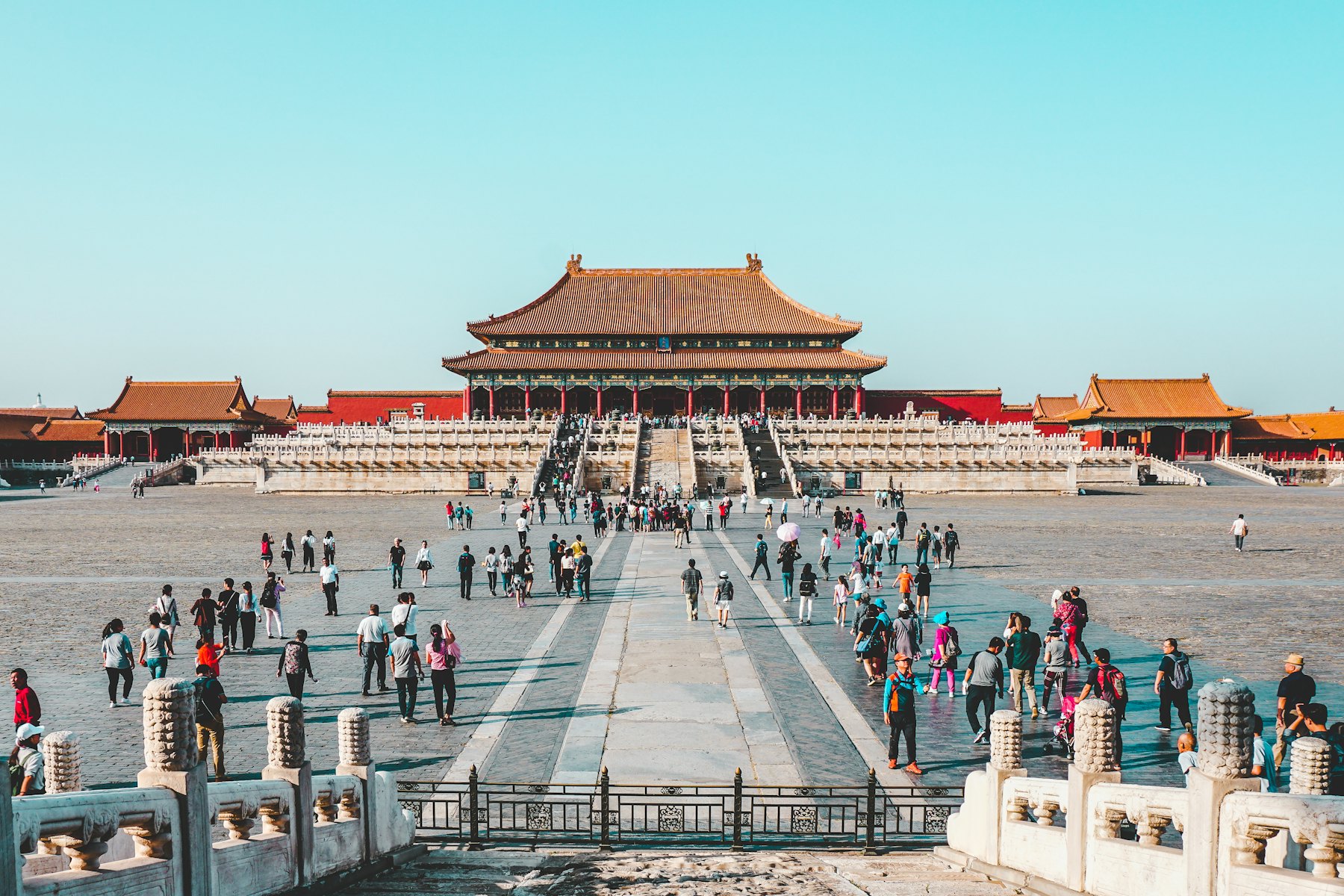
If you can, arrive at 08:00, half an hour before opening, at Tiananmen Square. The square is enormous and there is a security check, so it is worth passing through first and saving a deep visit for the way back. At 08:30 you enter through the south gate and give the morning to the Forbidden City following the central axis: the Hall of Supreme Harmony, the Hall of Central Harmony and the Hall of Preserving Harmony, where the great ceremonies of the empire were held. Each one is more imposing than the last.
After the axis, detour to the eastern and western side palaces. That is where the detail lives: small courtyards, minimalist gardens, red walls with golden eaves and almost no one. It is also where the treasures of the Qing dynasty are held, and where you understand how the court really lived, not just how it received. Exit through the north gate around 12:30, after about four hours.
To eat at midday, cross the road and enter Jingshan Park or head down to Shichahai; avoid the restaurants stuck to the north exit, which charge tourist-sight prices for mediocre food. A little further north, in the streets of the Dongcheng district, there are small noodle and dumpling places where local people eat.
Day 1, afternoon: Jingshan, Beihai and the Shichahai hutongs
Climb to the Wanchun Pavilion in Jingshan Park, directly opposite the north exit of the Forbidden City. It is about fifteen minutes of stairs and, from the top, you have the most complete panorama of the golden roofs of the imperial palace lined up on the city axis. It is the photo that sums up Beijing. Come if you can in mid-afternoon, when the light is softer and the gold of the tiles stands out against the sky.
From Jingshan walk west to Beihai Park and its lake, with the famous White Dagoba, the whitish stupa raised in the seventeenth century. Renting a rowing boat or simply circling the lake, you understand why this was the private garden of the emperors. Towards late afternoon, head down to Shichahai and get lost in its hutongs, the web of traditional alleys with square courtyards, bicycles and small bars.
This area is the best of the day for dinner. There is traditional Beijing cooking, from Peking duck to simpler neighbourhood dishes, and also modern restaurants by the lake. Leave time to wander at random: the living hutongs, with neighbours playing mahjong at their doors, are the most authentic thing you take from the capital.
- 08:00 — Tiananmen Square and the security check.
- 08:30 — Forbidden City, central axis and side palaces.
- 12:30 — Exit through the north gate and lunch in Dongcheng.
- 15:00 — Jingshan Park and the panorama over the imperial roofs.
- 16:30 — Beihai Park and the lake, optional rowing boat.
- 18:00 — Shichahai hutongs, a walk and dinner by the water.
Day 2, at dawn: the Temple of Heaven with the locals
The Temple of Heaven opens very early and is worth an early start even if you are not a morning person. Before 08:00 the park gardens fill with locals practising tai chi, dancing, playing instruments, writing calligraphy with water on the ground or playing cards under the trees. It is an everyday, free and authentic spectacle, far more interesting than any show staged for tourists. At weekends there is even more activity.
The complex itself is a masterpiece of symbolism: the circular temple with its triple blue eave, the terrace where sacrifices were offered and the Echo Wall, which returns the sound of a whisper. The emperors of the Ming and Qing came here twice a year to ask for good harvests. The symmetry of the whole enclosure, aligned with heaven and earth, is best understood if you arrive with the raking light of dawn.
To get there, the metro has its own stop on Line 5 at the east gate, and also on Line 8. The park ticket and the temple ticket are paid separately and the cost is small. After the visit there is plenty of time to grab breakfast at the stalls nearby before continuing the rest of the day.
Day 2, midday: Lama Temple, Confucius and Qianmen
From the Temple of Heaven, take the metro up to the Lama Temple, the Yonghegong, which is still an active place of worship rather than a relic: there is incense, pilgrims and monks. Its twenty-six-metre Buddha carved from a single sandalwood trunk is impressive. Next door is the Temple of Confucius, with its forest of engraved stone stelae and a silence that contrasts with the bustle of the city.
In the afternoon, head down to Qianmen, the reconstructed commercial street south of Tiananmen, with traditional facades and century-old shops. If tourism tires you, step into the parallel hutongs, such as Xianyukou, where the life of the neighbourhood continues intact and there are street food stalls. Finish with a Peking duck dinner: ask for it to be carved at the table, that is the correct way to eat it.
If you still have energy, the Peking Opera puts on performances that, with a prior introduction, are quite enjoyable even without the language. The key is knowing the story in advance: the gestures, the colours of the characters and the movements are codified, and once you know them the show makes sense.
Day 3: Mutianyu, the Great Wall without the crush
On the third day you leave the city. Among the nearby sections, Mutianyu is the best balance of landscape, state of conservation and crowding: it has restored wall, well-preserved towers and wide views of ridges, and fewer groups than Badaling. The distance from the centre is about seventy kilometres, roughly two hours depending on traffic, so the norm is to leave between 07:00 and 08:00.
The comfortable way up is the cable car, which drops you at the upper part and skips the long slope; to come down, the metal toboggan is fun and very popular with families. Once at the top you can walk along several kilometres of wall between towers, with fairly steep climbs and descents in some stretches. If you want the wall almost empty, walk fifteen minutes in either direction from the cable car station and the people disappear.
Eating up there is limited: there is a restaurant at the base aimed at tourists. Better to carry water and some fruit and have a late, calmer meal back in the city. If you would rather not drive or depend on buses, JoyoTour organises the private transfer to Mutianyu with a driver and a licensed English-speaking guide, with hotel pickup at whatever hour you set to beat the coaches. In the afternoon, if time remains, the 798 district, the old factory complex turned into contemporary art galleries, is a good way to close the trip and very different from everything before.
Where to eat each day
Beijing cooking is not just Peking duck, though Peking duck deserves a dedicated meal. The dish is a ritual: served with thin pancakes, spring onion, cucumber and sauce, and eaten by assembling each bite by hand. The best restaurants are in the Dongcheng and Chaoyang districts, and it is worth booking, above all at weekends.
- Peking duck: the star meal; book a table and ask for it to be carved in front of you.
- Jianbing: a savoury pancake with egg and sauce, the most common street breakfast.
- Zha jiang mian: wheat noodles with fermented soybean sauce and vegetables, a very cheap neighbourhood dish.
- Dumplings and steamed buns, ideal for a light dinner in the hutongs.
- Northern-style lamb hotpot, perfect if the day has been cold.
Outside the centre, the choice is so wide that you can eat well for less at the food markets and in locals' eateries. The rule is simple: if the menu has no photos and no one is speaking English, it is probably the best place on the street.
If you only have 2 days: what gets cut
Two days in Beijing are enough for the essentials if you accept giving something up. What you cannot remove is the Forbidden City with Jingshan, because it is the heart of the city and its scale is unique, and neither can you skip the Great Wall, because seeing it justifies the trip on its own. With those two pieces taking a day each, the rest compresses into the spare hours.
The way to cut is to sacrifice the full second day. Keep the Forbidden City on day 1 in the morning and add Jingshan at midday. In the afternoon, instead of the northern temples, do the Shichahai hutongs and eat in the area. On day 2, start early for the Temple of Heaven, give it two hours and head straight to Qianmen before taking transport to the wall. What falls away with this cut is the Lama Temple, the opera and 798, which are good additions but not essential on a first visit.
One warning: do not try to fit the wall and the Forbidden City into the same day. It can be done on paper, but the result is an exhausting race in which you enjoy neither. If time really is tight, it is better to choose the wall and leave the palace for another occasion than to do both flat out.
Mistakes that ruin the itinerary
The most common mistake is booking the Forbidden City late and without a ticket. It is the most in-demand sight in the city and the quota system does not forgive; anyone who turns up without a booking is left outside with no way to fix it. The second mistake is pedalling against the traffic: trying to cross the city from end to end several times a day. Better to group by zones, as this plan does, and move by metro.
The third mistake is not leaving a day for the wall outside the city, and the fourth is ignoring Mondays, when the Forbidden City and several museums close. With those four points solved, three days are enough to see Beijing well, without the crush and with time to sit down and eat without watching the clock. And if you would rather have someone tie it all together from the start, ChinaTour.es, the English-language site of the JoyoTour group, fits this same skeleton to your hours, your tickets and your pace.
Shall we organise your three days in Beijing?
Tell us your dates and whether you want to add the wall or a less touristy section, and an English-speaking adviser returns the itinerary with tickets, guide and transfers. Message us on WhatsApp and we have it ready within three business days.
Message us on WhatsAppWe're the destination agency behind ChinaTour.es. JoyoTour has been designing tailor-made trips since 1999 and has 150 itinerary designers across China, Southeast Asia, Europe and the Americas. More than 100,000 travellers have set off with us. Everything we write about here, we've travelled first.