
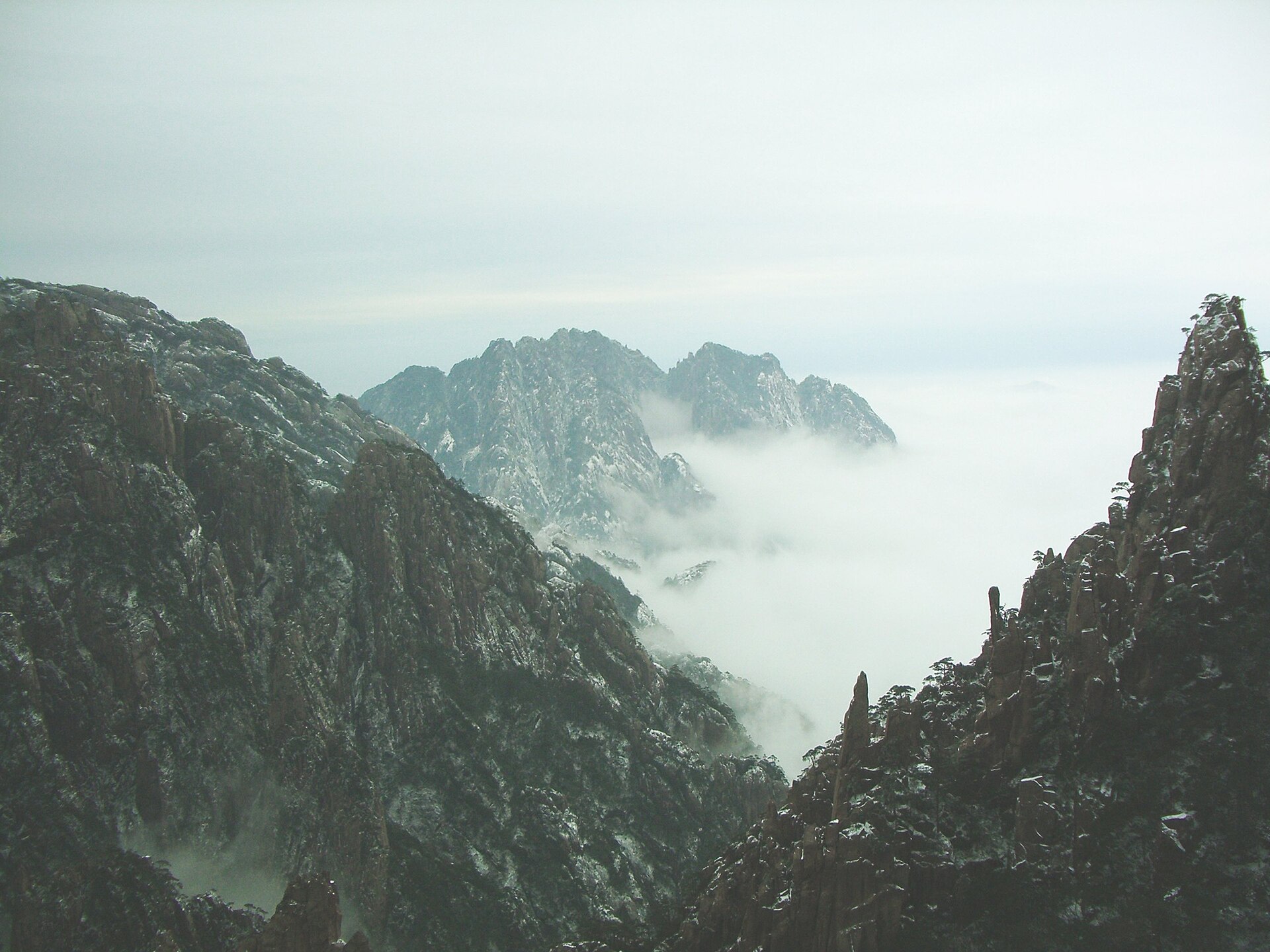
Huangshan, the Yellow Mountain, is the most painted landscape in Chinese art: granite peaks, twisted pines growing out of cracks, and a sea of cloud that swallows whole valleys and leaves the summits floating. It earns the reputation. It also has a specific logistics problem, and understanding it is what separates a memorable visit from an exhausting one.
That problem is light. The mountain is at its best at dawn and at dusk, when the cloud sits low and the ridges line up one behind another. But the cable cars stop running in the late afternoon, and the only way to be up there at sunrise is to spend the night on the summit — which means booking weeks ahead, paying summit prices and carrying your own bag up a large number of steps.
The second half of the trip is what most people underestimate: the villages. An hour from the mountain, in the same county, Hongcun and Xidi are two of the best-preserved Ming and Qing villages in the country, both UNESCO sites, and together they explain the region in a way the mountain alone cannot.
What Huangshan is, and how the visit actually works
Huangshan is not a single peak but a cluster of granite summits, the highest of which, Lotus Peak, reaches 1,864 metres, with Bright Summit and the Celestial Capital Peak alongside. The park entrance costs roughly CNY 190 in high season and around CNY 150 in low season, and it does not include the cable cars, which are charged separately at roughly CNY 80–100 for a single ride.
There are three main cable cars: Yungu from the eastern side, Yuping from the south, and Taiping from the west, all of them ascending from different valleys to different ridges. Choosing which one to go up and which to come down is the central decision of the whole trip, because the walking distance between the upper stations is measured in hours, not minutes.
The traditional list of the mountain's four wonders is oddly shaped pines, granite peaks, the sea of clouds and the hot springs at the foot. In practice, three of the four are visible on foot and the fourth is a hotel spa. What most visitors actually remember is the cloud: it arrives around dawn, fills the valleys for an hour or two, and then lifts.
The classic two-day route, in the right order
Go up on day one in the late morning and come down on day two after sunrise. The reason is simple: the climb is hard on the legs and easy on the eyes, and walking down endless stone stairs is far kinder than walking up them with a bag.
Day one: take the Yungu cable car up from the eastern side, walk to Beginning-to-Believe Peak and on through the Beihai area to your summit hotel, dropping your bag before lunch. The afternoon is for the western viewpoints and the Beginning-to-Believe forest of pines. In the evening, walk out to Bright Summit for sunset, which takes twenty to forty minutes from the hotels depending on which one you are in.
Day two: up before dawn for sunrise from Bright Summit or Danxia Peak, then back for breakfast and the descent. The best descent is through the West Sea Grand Canyon, a loop of vertiginous steps cut into a cliff, followed by the Yuping cable car down, passing the Flying-Over Rock and the Greeting Pine, the most photographed tree on the mountain. Allow four to five hours for the whole descent.
Where to sleep: summit, foot or valley
Sleeping on the summit is the only way to see sunrise and sunset properly, and it is expensive. The handful of summit hotels offer standard rooms at roughly CNY 800–2,000 a night in season, and dormitory beds at around CNY 200–400. They are functional rather than luxurious, they fill weeks in advance in October and on public holidays, and the food is basic and priced accordingly.
The alternative is to sleep at the foot, in Tangkou village beside the transfer station, or in Huangshan city, an hour away, and to go up and down in a single day. That works if the weather is clear and you accept missing both the dawn and the dusk, which are, unfortunately, the two reasons people come.
| Where to sleep | Roughly per night | You get | You give up |
|---|---|---|---|
| Summit hotel | CNY 800–2,000 | Sunrise and sunset on the ridge | Money, comfort, a heavy bag |
| Summit dormitory | CNY 200–400 | The same views for less | Privacy and a decent night |
| Tangkou, at the foot | CNY 250–600 | Cheap, easy, flexible | Both golden hours |
| Tunxi, in the city | CNY 300–800 | Restaurants and Old Street | An hour each way to the gate |
Hongcun and Xidi: the villages worth the detour
An hour from the mountain by road, Hongcun is the most photographed village in China and the setting of a famous wuxia film. Its centrepiece is the Moon Pond, a semicircular pool in front of the village hall that mirrors the whitewashed walls and dark tiled roofs, and behind it a network of narrow lanes and water channels that irrigate the whole settlement. Entry is around CNY 100, and the crowds arrive between ten and three.
Xidi, a fifteen-minute drive away, is quieter and in some ways more rewarding: a long, elegant main street of Huizhou houses, carved stone and wood, with fewer tour groups and a slower rhythm. Both villages are UNESCO World Heritage sites, and both are best in the first hour after opening and in the last hour before closing, when the day-trippers have gone and the residents are washing vegetables in the channels.
Stay overnight in one of the village guesthouses if you can. The Huizhou houses have courtyards open to the sky, carved wooden screens and a stillness at night that no day trip ever reveals. It also solves the light problem: at dawn, the Moon Pond belongs to whoever is standing there, and there are usually only three or four people.
Tunxi, Shexian and the rest of Huizhou
Huangshan city, also called Tunxi, is where the trains arrive and where the region's other sights begin. Tunxi Old Street is a restored merchant street of two-storey Huizhou shophouses selling inkstones, brushes, tea and wood carvings; it is touristic but pleasant in the evening, and the surrounding lanes are still lived in.
Half an hour north, Shexian is the old administrative heart of Huizhou and holds three sights worth a half day: the Tangyue archways, a line of stone memorial arches raised by a single merchant family, the Bao family garden, and the Yuliang dam and its ancient ferry crossing. Together with the villages, this is the part of the trip that explains where the money behind all those white walls came from.
Getting there and moving around
Huangshan North is the high-speed railway station, roughly two and a half to three hours from Shanghai, about an hour and a half from Hangzhou, and within a long day of Beijing. From the station to the mountain foot at Tangkou is another hour by road, so do not assume the railway station is near the park; it is not.
Within the region, buses connect Tunxi, Tangkou and the villages, but the connections are slow and not designed for luggage. Most travellers with limited time use a private car and driver, which also makes it possible to pair the mountain's foot with a village in the same afternoon, something no public bus timetable allows.
When to go, and when the cloud appears
April, May, September and October are the best months: mild temperatures, reasonable visibility and the mountain at its most photogenic. Spring brings mist and fresh green, autumn brings clear air and gold on the lower slopes, and both are busy at weekends and completely full during the first week of October.
The sea of clouds is most likely in late autumn and winter, above all the day after rain, when the valleys fill overnight and the peaks stand above them at sunrise. Winter also brings snow, which turns the pines into ink drawings, but ice can close the cable cars and the steps become genuinely dangerous. Summer is hot, humid and often lost in cloud for days, which is the one season to treat with caution.
What to pack and what it costs
The mountain is cold, wet and vertical. Layers matter more than anything else, because you will be sweating on the stairs and shivering on the exposed ridges within the same hour. Prices on the summit are roughly double those in the valley, so carry your own snacks and water, and keep some cash for the small shops that do not accept foreign cards.
- Shoes with a real grip: the stone steps are polished by centuries of feet and slippery when wet.
- A waterproof shell and a warm mid-layer, even in spring and autumn.
- A thermos, which every summit hotel will refill with hot water for free.
- A headlamp for walking to sunrise points before daylight.
- Cash in yuan for cable cars, drinks and the shuttle buses at the foot.
- A small day bag, because porters are expensive and the steps do not forgive luggage.
What to eat in Huizhou
Huizhou cooking is one of the eight great Chinese cuisines and is heavier and more savoury than most visitors expect: braised, fermented, smoked and preserved, which is what happens to food in a mountainous region with long winters. It is excellent in the villages, where the same dishes cost a fraction of the summit prices.
The dish to order is stinky mandarin fish, fermented and then braised, whose smell is alarming and whose taste is superb. Alongside it, look for bamboo shoots with cured pork, Hui-style braised pork belly, and the local maofeng green tea, which is one of China's finest and is sold everywhere from the mountain villages to Tunxi Old Street.
Doing the mountain and the villages well in a short window is mostly a question of timing, tickets and where you sleep. ChinaTour.es, the English-language site of the JoyoTour group, handles the summit booking, the cable car slots and the village nights with a licensed English-speaking guide and a private driver for the transfers, so the only thing left to decide is whether to get up for the sunrise.
Want Huangshan without the guesswork?
Tell us your dates and whether you want to sleep on the summit, and an English-speaking adviser sends you a plan with the cable cars, the villages and the transfers arranged. Message us on WhatsApp and the first draft arrives within three business days.
Message us on WhatsAppWe're the destination agency behind ChinaTour.es. JoyoTour has been designing tailor-made trips since 1999 and has 150 itinerary designers across China, Southeast Asia, Europe and the Americas. More than 100,000 travellers have set off with us. Everything we write about here, we've travelled first.