
Guilin and Yangshuo are sold together so often that many travellers arrive believing they are one place. They are not. They are two different towns about an hour apart, and the way you split your days between them decides whether you come home with photographs you keep or with a memory of queues, coaches and a river seen through a window.
The short version first. Guilin is a mid-sized city with an airport, a railway hub and a river running past famous karst peaks. Yangshuo is a small town sitting inside that karst, where you move by bicycle and bamboo raft. The landscape everybody photographs lies mostly between the two, along the Li River, and the best of it is around Xingping, an old trading town upstream from Yangshuo.
Why the pair works, and where it usually goes wrong
Guilin works as the arrival point: it has the flights, the high-speed trains and an evening of real city life. Yangshuo works as the base: it is compact, walkable and surrounded by the scenery you came for. The classic mistake is giving Guilin two nights and Yangshuo a rushed afternoon between two coach transfers, which is exactly backwards.
The second mistake is treating the Li River cruise as transport rather than as the main event. It is the main event. Once you have done the river properly and given the countryside a full day, everything else on the tourist circuit — the painted caves, the evening shows, the staged minority villages — becomes optional rather than essential.
- Give Yangshuo two nights minimum, Guilin one.
- Do the Li River once, in the morning, in a single unhurried stretch.
- Book the cruise as soon as your dates are fixed: quotas are real.
- Keep one full day for bicycles or a scooter in the Yulong valley.
- Add Longji only if you have a third night available.
Getting there: airport, stations and the transfer trap
Guilin Liangjiang International Airport (KWL) sits about 30 km south of the centre. A metered taxi into town runs to roughly CNY 100–130 and takes forty minutes; the airport shuttle bus is around CNY 20 and drops at several central points. Both are fine, but at night, after a delayed flight, the private transfer is the difference between a calm arrival and an argument in a car park.
On the rail side, be careful: Guilin has more than one station, and they are not close to each other. The high-speed trains mostly use Guilin North, while slower services use Guilin Central and Guilin West. Guangzhou is roughly two and a half hours away, Changsha about three, and Shanghai or Xi'an a long day of eight to nine hours, which is why most travellers fly those legs instead.
The trap almost nobody sees coming: the station called Yangshuo is not in Yangshuo. It sits roughly 30 km outside town, so you still need a bus, a taxi or a pre-arranged car at the other end. If you are travelling with luggage and without a word of Chinese, arranging that last leg in advance is worth far more than the few yuan it costs.
Guilin city: two hours, not two days
Guilin is pleasant and gets more attention than it deserves. The Reed Flute Cave is genuinely impressive, a limestone cavern the size of a cathedral lit in colours that look absurd in photographs and much better in person. The Two Rivers and Four Lakes night boat, with the Sun and Moon Pagodas reflected in the water, is a good way to close a first evening without walking far.
Two landmarks are routinely oversold. Elephant Trunk Hill is a ten-minute stop and the best view of it is from the far bank, for free, rather than from inside the paid enclosure. Fubo Hill is a short climb with a decent city panorama but nothing you cannot skip. If your time is limited, spend the hours in Guilin on food and rest rather than on tickets.
The Li River: how to do it properly
The cruise runs from the piers north of Guilin down to Yangshuo, roughly 83 km in four to four and a half hours on a four-star boat, with a simple lunch served on board. Published rates sit around CNY 270–450 depending on boat class, and booking two or three days ahead is normal; in the first week of October it is essential. Subject to local published rates, and the price is not the part worth optimising.
Two decisions matter more than the price. Take the earliest departure you can, because the mist sits on the peaks for the first hour and the light is soft; by eleven the haze has flattened everything. And ask for a seat on the upper deck or at an open window rather than the interior cabin, where half the journey happens behind glass.
The scenery peaks in the middle stretch, and the postcard everyone wants — the one printed on the twenty-yuan note — is near Xingping, close to the end. The river is not a theme park: it carries working boats, bamboo rafts and fishermen, and the quieter stretches between the highlights are often the ones you remember.
Yangshuo: base, bicycles and the traffic problem
West Street at night is loud, commercial and easily skipped after a quick look. The town's real value is as a base: small guesthouses, cheap restaurants and, above all, the ability to leave it in ten minutes on a bicycle. Bike hire runs at roughly CNY 30–60 a day and a scooter around CNY 80, both usually against a deposit and your passport; inspect the brakes before you pay.
The Yulong River valley south-west of town is where the postcards are made: bamboo rafts with a punter, paddle fields, water buffalo and karst walls closing in on every side. A raft for two costs roughly CNY 200–300 depending on the section. Moon Hill is a steep forty-minute climb through a natural arch, with a small ticket, and the view is worth the sweat if the air is clear.
The one genuine annoyance is traffic. The main road through Yangshuo congests badly in the late afternoon, when day-trippers return and rafts queue at the landings. Start early, be back in town by four, and you will see a different, calmer place than the one the coach tours meet.
Longji rice terraces: the day trip people get wrong
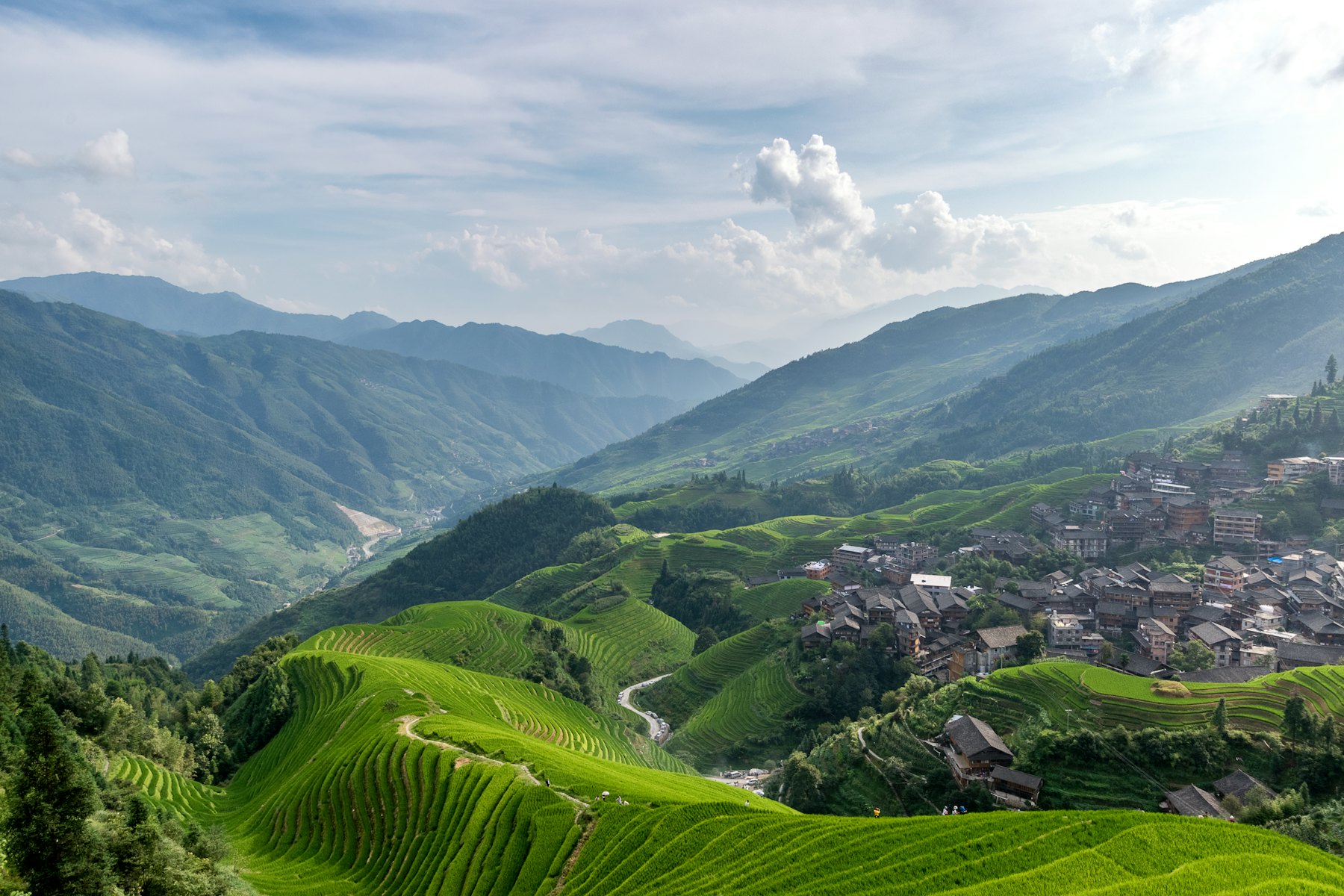
The Longji terraces, roughly two hours north of Guilin and about 100 km away, are one of the most striking human landscapes in China: hillsides carved into thousands of narrow ribbons of rice, some of them centuries old. There are two main villages, Ping'an and Dazhai, with a cable car at Dazhai and a long staircase at Ping'an. Entry to the terrace area is around CNY 80, with the cable car charged separately.
Doing it as a rushed day trip from Yangshuo is the mistake, because the transfer is three hours or more in each direction and you arrive exactly when the coaches do. Stay one night in a guesthouse in Ping'an instead, walk out at dawn, and you will have the upper terraces to yourself, with mist in the valleys and the Yao women carrying baskets up the stone paths.
Timing decides what you actually see. The paddies are flooded and act as mirrors from late April to early June, brilliant green in July and August, gold just before the harvest in late September and October, and bare earth through the winter. All four are worth photographing; only one of them is what you pictured.
What it costs and where to sleep
Figures below are per night for a double room, mid-range, and should be read as ranges rather than quotations: Chinese hotel categories do not map neatly onto Western ones, and a local three-star is not a European three-star.
| Where | Type | Roughly per night | Why |
|---|---|---|---|
| Guilin | City hotel, 3–4 star | CNY 250–500 | Flights, trains and an evening of restaurants |
| Yangshuo | Boutique guesthouse | CNY 400–900 | Walk to the river and the bike hire |
| Xingping | Riverside inn | CNY 300–600 | Sunrise over the best bend of the Li River |
| Longji (Ping'an) | Family guesthouse | CNY 200–400 | Sleep inside the terraces, walk out at dawn |
If someone else is handling the logistics, ChinaTour.es, the English-language site of the JoyoTour group, builds this route with a licensed English-speaking guide and a private driver, and sets the Li River departure and the Longji transfer at the hours that avoid the group coaches. Groups are capped at twelve travellers, and any village visit at six, with the fee paid directly to the family.
When to go, and when not to
April to June brings rain and the famous drifting mist, which is beautiful and wet in equal measure; pack accordingly and accept that some boat departures are cancelled after heavy rain. July and August are hot and humid, with temperatures of 33–36°C and afternoon storms. September to November is the most reliable window: dry, clear and mild.
December to February is cold, damp and grey, with lower water in the river and bare terraces, though the crowds vanish and prices drop. Two periods to avoid entirely if you can are the first week of October, when the whole country travels at once, and Chinese New Year, when trains, hotels and riverside boats are full weeks in advance.
What to eat in Guangxi
Guilin rice noodles are the local staple and one of the best cheap meals in China: a bowl of slippery rice noodles with braised meat, peanuts and pickles costs roughly CNY 8–15 and is eaten for breakfast by everyone. Order it dry first, then add the broth from the pot at the table, which is how locals do it.
- Guilin rice noodles (mifen): breakfast, CNY 8–15, add your own broth.
- Beer fish (pijiu yu) in Yangshuo: a whole river fish braised with beer and tomato, CNY 100–160 to share.
- Stuffed river snails: a local speciality, ordered by the plate.
- Oil tea (youcha) in the Longji villages: bitter, savoury and a genuine local ritual.
- Fresh pomelo and persimmons from the market: sold by weight, cheaper than anywhere in Europe.
Small decisions that save a day
Most trips to this region lose their time in the same four places: at the wrong railway station, in the queue for a boat they did not book, in a car crossing back and forth along the same valley, and on a Longji day trip that should have been an overnight. Fixing those four things costs nothing and changes the trip completely.
Book the river ahead. Confirm which station your train actually uses. Base yourself in Yangshuo rather than Guilin. And treat the karst as something to move through slowly on two wheels, not as a set of viewpoints to tick off from a coach window.
Want this route built around your dates?
Tell us how many days you have between Guilin, Yangshuo and the terraces, and an English-speaking adviser sends you an itemised itinerary with the river, the guide and the transfers arranged. Message us on WhatsApp and the first draft is ready within three business days.
Message us on WhatsAppWe're the destination agency behind ChinaTour.es. JoyoTour has been designing tailor-made trips since 1999 and has 150 itinerary designers across China, Southeast Asia, Europe and the Americas. More than 100,000 travellers have set off with us. Everything we write about here, we've travelled first.